Central Intersection

A place where ideas on health, fitness and awareness come together to help make sense of our bodies, relationships and careers. The Central Intersection is where ideas from many sources are connected to help create a unifying theory. I feel I need to add a common sense disclaimer so... This blog is designed to be a dialogue of discovery. It is not intended to serve as medical advice or diagnosis.

Friday, March 13, 2015

Basic Foot Series

This is a copy of a post you can find on my ski-specific blog Snow Deva... I figured I would share it here as well as it lends itself to a variety of interesting conversations!

This is based on work I have done with Sara Azarius from Yoga on Centre - she is a wonderful resource and is an amazing yoga instructor.

I presented an abbreviated version of this work at the final 2010-2011 Winter Diva's Wednesday. It is wonderful to treat your feet after having them in a pair of ski boots... or any other restrictive footwear all day :)

Let me also take a second to thank my wonderful sister Kimm Viebrock who is not only the model but took the time to type up the handwritten notes I scrawled for her to follow :)

Enjoy! Let me know if you have questions or comments.

Namaste!

Kjerstin Klein


Basic Foot Series
This series is designed to open up the joints and stretch the muscles of the lower leg and foot.  This is a critical component of re-adjusting after being in ski boots or other footwear that is rough on the feet.  It will also help to build the muscle of the lower leg and feet while improving resilience in order to absorb impact and support the rest of your body effectively.


Retraining and Building Awareness in the Lower Leg and Foot


Start by standing with feet together.
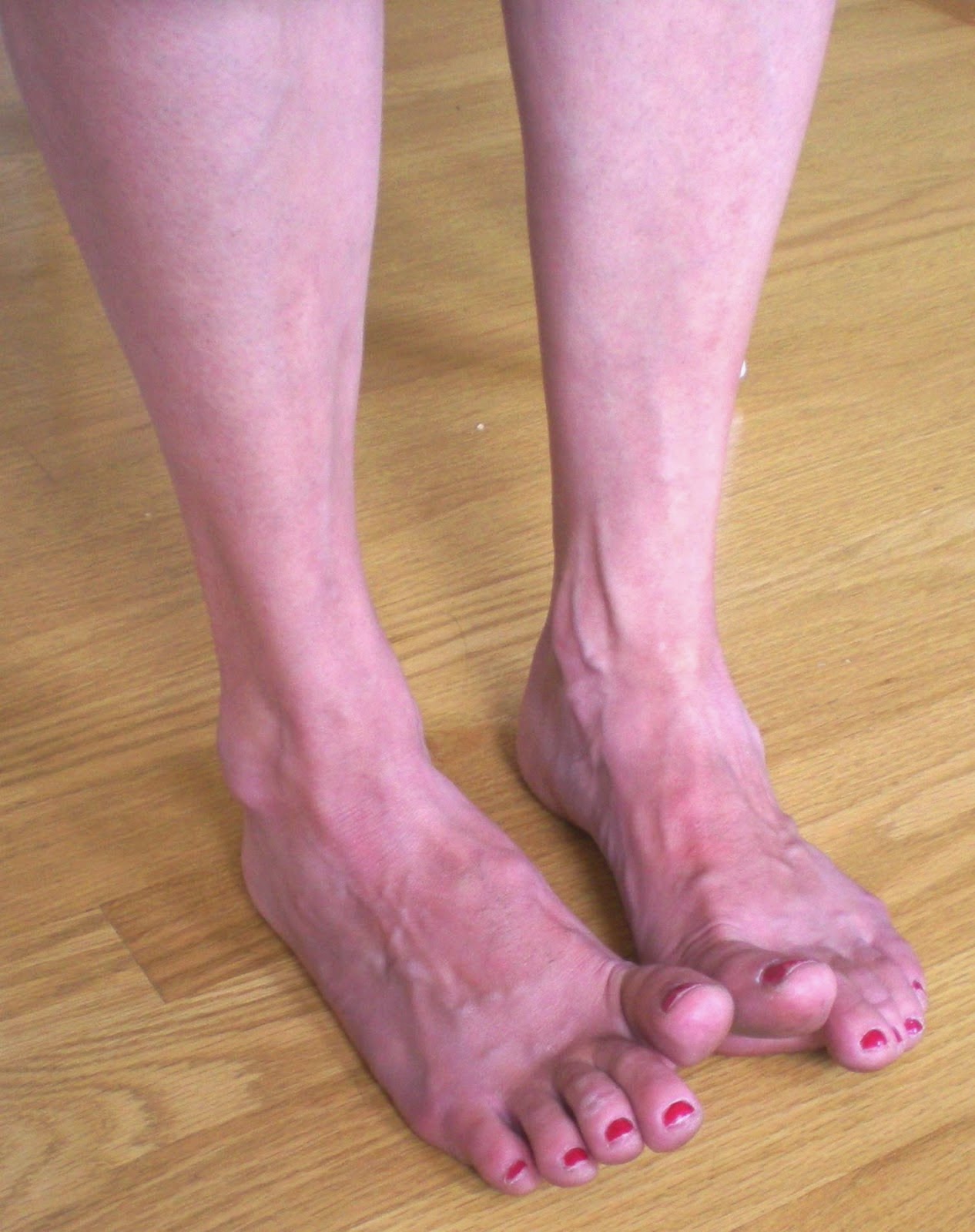
Re-position heels so that outside edges of feet are parallel.


Lift toes while pressing ball of the foot behind the big toe and also behind the small toes into the floor. Work at spreading all toes wide and lifting the arch from the bottom of the foot rather than from the top of the foot. This means do not use your ankle to move your arch further from the floor - it means use the muscles of your foot to actually contract your arch lifting it from the floor.


Opening the Ankle with Lateral Movement


Widen stance to beyond shoulder width, keeping outside edges of feet parallel. Ankles will be bent to accommodate stance.


Rotate onto inside edges of feet to straighten ankle.


With ankle straightened, begin working to flatten outside of foot back toward the floor.


Keeping all other elements in place, lift the big toe.


Keep stretching toes outward while lifting big toe and lifting arch from beneath the foot. This means do not use your ankle to move your arch further from the floor - it means use the muscles of your foot to actually contract your arch lifting it from the floor.


Opening the Knee with Flexion


Place a cushion on the floor and kneel on the cushion. Prior to settling all the way to a sitting kneel, adjust the knees upward and place a rolled up blanket or yoga mat as far into the bend of the knees as possible. Settle back into a sitting position as far as possible, using a yoga block for support where needed.  To 'adjust knees upward' simply reach below your knee cap and draw the skin of the knee back towards you - this will help to relieve some of the tension on the knee making the position more comfortable.

Repeat, moving the blanket/mat to mid-calf .

Repeat again, moving the blanket to where the calf muscle ends just above the ankle.


Opening the Ankle with Flexion


Hold onto a door for bracing and place the foot flat upon the door, bending knees and body as needed to make this possible.


Continuing to brace against the door, slide the foot slowly downward until the heel touches the floor (The white paper you see is because she kept sticking to the door - we needed to create a surface she could slide on to move her foot :).


Begin re-positioning body to a vertical position close to the door, allowing heel to move outward.


Continue re-positioning the body and the foot until foot is flat on the floor with only the toes still in vertical position against the door.


Opening the Big Toe Joint with Traction


Begin toe traction by placing the weight of the heel of one foot onto the large toe of the other foot. Shift the body weight to the balls of both feet, allowing the back foot to raise the heel while keeping the big toe in place.


Bring the heel of the rear foot down and back while keeping the large toe in place with the weight of the front foot. As the rear foot is lowered, it will be stretched slightly with that tension.


Opening the Forefoot, Aligning the Big Toe


Sit on a chair with heels approximately a yoga block-width apart while angling toes towards one another (pigeon toed). Slide a yoga block between your feet and loop a yoga strap around the big toes, bringing it snug. Slide the yoga block slightly forward into place with the front edge ending at the big toe joint. Narrow the heels so the entire length of your foot makes contact with the block introducing some tension at the toes.  Stand up from chair if possible.

Stretching Muscles, Tendons and Fascia From Ankle to Toes


Wrap or tie a yoga strap snugly around the ankles, then gently lower into a kneeling position on a cushion. Before settling, adjust knees upward then sit on heels with toes forward, flat on the floor.  To 'adjust knees upward' simply reach below your knee cap and draw the skin of the knee back towards you - this will help to relieve some of the tension on the knee making the position more comfortable.


Repeat with feet and toes pointing directly backward so that the tops of the feet are on the floor. Support body weight with hands as necessary.


Stretching the Muscles, Tendons and Fascia of the Lower Leg with Extension
Kneel on a blanket on the floor, manually re-positioning calf muscles outward and adjusting knees upward, then settle down into a sitting position between the legs, with feet pointing directly backward. Tops of the the feet will be on the floor. Have a rolled up blanket and/or yoga mat (or two) positioned lengthwise directly behind along with a yoga block positioned for a headrest.


Lie backward onto the blanket, using a yoga block for a headrest if needed, allowing the upper legs to stretch and the chest to open up.


REST
Rest and assimilate all of the previous work in Savasana with a rolled up blanket supporting the knees and another rolled up blanket as a headrest.


It may be difficult to achieve benefit from these poses without knowledgeable help.  Please feel free to contact me at any time should you require clarification.  Please do not attempt any of these poses if they cause pain in anyway, As always, use common sense, this post, and all others on this site are not meant as medical advice.

Labels: , , ,

Wednesday, February 24, 2010

Lose Belly Fat Fast and Free

Lose Belly Fat Fast and Free - just read my blog and I'll tell you how!

Ok, I'm sick of it! I probably owe you a bit of an apology right up front because this is about to be a bit of a rant...I'll try to tone it down so that more of you are likely to read further and hopefully gain some insight, after all, that is what Central Intersection is supposed to be about - not just someplace for me to blow off steam.

Americans have gotten a bad rap for being unfit and out of shape. I admit that there are many unhealthy people out there but frankly - they probably aren't the ones scouring the Internet for ways to lose belly fat - they just don't care enough to go that far. For those of you who DO care, you probably have done all of the 'normal' things...you eat well, or decently enough, you do some form of exercises but you've been convinced that you have to lose belly fat or suffer being imperfect.

It is easy to see how you've been convinced. Not a day goes by that I'm not inundated with magazine covers promising me miracle ways to lose belly fat, Internet banner ads flicker across my screen "Pittsburgh woman discovered how to lose belly fat, click here to learn her secret" skyscraper ads make promises to lose belly fat and even show some dynamite animated graphics that show how adorable I would be if I were just to loose belly fat! Adsense is littered with Lose Belly Fat ads - and I guess, since Central Intersection doesn't rank very highly, I tend to attract low cost adsense ads but I see 'lose belly fat' junk all day and I have to admit - I often get curious and I know better!

Well - let me help you, hopefully then you too will know better and not fall prey to this senseless advertising. Now I understand you are smart and can sense a scam from a mile away - so you probably have been smarter than me and never clicked on one of the silly ads I've mentioned above...but they probably piqued your interest - "what do they know that I don't know?" or thought "Yes, I could lose a few pounds and it does happen to be around my belly" so what's the harm? The harm is that all of this advertising has convinced you that you have to lose belly fat and 9 times out of 10 it is posture that is your problem not belly fat.

Yes, posture. I'm sure you stand relatively erect. Your shoulders are back and your chin doesn't jut out but there is more to it than that.

If you have been convinced that belly fat is your issue my guess is that you have spent hours in the gym or on your bedroom floor doing crunches and core exercises and done the whole 'feel-it-burn' routine. It may surprise you that it is the very thing you are doing to lose belly fat that is causing what appears to be belly fat.

If you are doing crunches and traditional core exercises that focus on the abdominal muscles you are creating an imbalance between the muscles of the back body and the muscles of front body. Aside from the spinal issues that this can cause it also can act to disengage the intrinsic muscles that are responsible for holding your upper body erect - forcing larger muscle groups to activate and take over a job they were never designed for. This can lead to fatigue and injury but even more important it can essentially cause a collapse of your carriage. With the shortening of the abdominal muscles and the pulling of the shortened front body against the weakened muscles back body the entire upper body becomes shorter, more compact.

A shorter, more compact upper body can lead to a multitude of issues; digestive problems, bladder, kidney and prostrate issues, endocrine problems and uterine issues - its not a pretty sight but the worst of all of it is the darn belly fat!

Ok, its not really belly fat - sure most of it is fat but those rolls aren't necessarily a problem. If they covered more surface area for example, they wouldn't LOOK bad and honestly, isn't that what we are after? We want to look better.

The reason those rolls appear around your middle is because you have telescoped your body enough to cause the skin and underlying structures - fat included - to have to fold over to take up less space. This effect can be seen if you lay a hand towel down on a hard/slippery surface and push the ends towards one another - the fabric bunches up into several rolls right?

You see this also in your upper back - those unsightly rolls that push out around your bra strap...they want to sell you SPANX to cover those up don' they? You don't need SPANX you need to work on your posture!

Ok, I hear you - you are calling B.S. - you don't believe a word I'm saying do you? Ok, test it for yourself. Hang upside down - find a chin-up bar or go to a kids playground and just hang yourself upside down. If hanging upside down is impossible for you then we need to have another conversation but until then you can get a similar effect if you hang by your arms upside right but then you don't have a free hand to pinch with :)

When you hang you will notice that all of those bumps and rolls go away - now give a yourself a pinch and see that there isn't as much there as you thought. This is a far better representation of what you body should look like if you were to use it properly. Now it is true that by hanging you will have gravity providing a bit more traction than your intrinsic muscles would provide but I believe that the tension most people hold in their muscles and connective tissue will counter balance the traction.

The fact is that most of us could be significantly taller - there for spreading our 'belly fat' over more surface area - if we simply used our bodies with greater efficiency and stood at our full height so that our outer layers didn't have to fold and roll to accommodate our shortened stature.

So, now I'm sure you want to know how to do that. Well to undo all of the years of core exercises you have been duped into doing I suggest you go and find your local Iyengar Yoga studio. Now I will agree that it is the teacher not the style that makes for quality yoga but I feel that the Iyengaries, as a rule, have a better understanding of biomechanics and structural alignment; most other styles accommodate the yoga to fit the body not the body to fit the yoga.

Iyengar yoga relies heavily on props and supports to make the biomechanically correct poses available to all levels of fitness and flexibility. Iyengaries will teach anyone, at any level. Yes, it is work, work in a different way than most westerners are used to doing work - it builds awareness and brings change - the exact change you will need should you care to really lose belly fat.

Namaste,

Kjerstin Klein
Central Intersection

Labels: , , , ,

Friday, January 09, 2009

Tart Cherry Juice and Salt Baths After A Tough Workout

Since I sent a tweet out on taking a shot of tart cherry juice and a salt bath to stave off soreness after a tough workout I have been bombarded with question about the how's and why's - I realize this is a way oversimplified explanation but hopefully it will provide a basic answer to those questions.

DOMS stands for Delayed Onset Muscle Soreness. It is that miserable “Oh my GOD I can't walk feeling you get the day or two after a hard workout. It is commonly thought of as a result of a build up of lactic acid in the muscle.

Lactic acid is a metabolic byproduct of working out – well, any anaerobic muscular activity and current research indicates that it may have little to do with causing DOMS – but that doesn't mean that they aren't related. Lactic acid or lactate is created when the body is forced to produce energy in low oxygen conditions – when you are 'sucking wind' so to speak or when muscular requirements exceed the bodies capacity to deliver oxygen – as in an all out sprint as opposed to distance running. Lactic acid is easily broken down and used by the body once oxygen levels return to normal but when the rate of production exceeds the rate of breakdown you get lactic acid build up which will eventually decrease the muscles capacity to work – you know the feeling, when you are lifting weights and the first rep is easy but the last is a killer. With the build up of lactic acid the body is thrown out of balance – but with time it brings itself back into balance and all is well again.

For years it has been thought that this lack of balance was the cause of DOMS – kind of a self protection mechanism to keep the body from compounding the problem before it was back in balance again. The other issue, however, is that the type of muscle work that results in this lactic acid build up also tends to be the type of muscle work that leads to micro damage in the muscle fibers – this how we get bigger muscles – it is called hypertrophy – we break down the muscle tissue and it rebuilds bigger and stronger. These micro tears are no big deal but is damage to the body which stimulates an immune response which includes an inflammatory response as the body initiates a repair response. As a result of the tears there is an elevation of metabolites and cellular material leaks into the interstitial fluid (the liquid that surrounds the cells). The intercellular environment is far different than the extracellular environment and it appears that this imbalance and the subsequent inflammatory-repair response is more closely related to DOMS than lactic acid build up.

The key here is that given time the body can heal just fine on its own but it would be nice if we could give it some help. Help means less discomfort, and less stress on the body allowing for more resources to be spent on things like fighting viruses and other germs or just getting through the day without feeling exhausted.

There are three key things that I feel are paramount to aiding the body after a tough workout.

1. Pranyama – ok, it is a fancy word for deep breathing and while it is far more effective if you do it with some skill it is one of those things that you can without having a clue as to what you're doing and still have a positive effect. Deep breathing has been shown to be one the best ways to reduce acid levels in the body and is amazingly effective on lactic acid build up. While getting oxygen into the body is important the exhalation is even more important. Allow your breath to come in naturally – don't force it – but make sure to focus on the exhalation and exhale completely, past what you normally would before you inhale again.

2. Tart Cherry Juice – not the nicest juice to just sip but it isn't terrible. It is best when mixed with another juice but can be done as a shot just to get it over with. Take about 2 oz 1-3 times a day. It isn't a bad idea to just do it everyday for no reason but critical after a tough workout. Tart cheery juice not only helps to reduce the bodies acidity but it also has anti oxidants that support the break down of the metabolic waste left over from the micro tears.

3. Salt Baths – I don't mean a teaspoon of salt in a giant bathtub, I mean a high salt content bath. If you live near the ocean just go jump in and stay there for a bit. If you aren't so lucky soak in a tub filled with the hottest water you can stand and an entire box of salt for as long as you can stand it – 20 minutes minimum. My two favorites salt choices are the 3 lb box of Morton's Kosher salt or a 4 lb box of generic Epsom salt. There are all kinds of things that you can add to these baths to make them even more effective but I'll keep it simple for now. Soaking in salt creates an osmotic response in the body – higher concentration of salt outside the body will cause interstitial fluid to flow out of the body to try to dilute it taking the undesirable metabolites and waste with it. I'm sure you can see the need to drink plenty of water and electrolytes afterwards.

I hope this helps – I look forward to your comments!

Namaste,

Kjerstin

Labels: , ,

Friday, October 17, 2008

Our Amazing Machine

Everyday of my life I have the opportunity to be amazed at this wonderful machine we call the human body. I have been fascinated by it from my early childhood. One of my mother's favorite stories is from my preschool years. As my brain was churning on the amazing structure of the nose I could not wrap my brain around its purpose and what would happen if it was injured – say you got punched in the nose – sure, it would hurt, I got that but what would happen inside? I was convinced that it was too small for blood vessels and a punch was not a cut so it wouldn't bleed. Would it turn purple like a bruise? Would it swell like an ankle?

I decided direct experimentation was the only route. Knowing that my older sister would not let me try it on her, and besides I couldn't wait long enough for her to get home from school, I decided that self experimentation was the only way. Having chosen the best time to catch her when she was not really paying attention I yelled to my obviously busy mother in the other room “Mom! Can I punch myself in the nose to see what happens?” “Uh-hu, whatever dear,” came the brush-off reply. To this day I am impressed by the power I was able generate against my own better judgment and sense of self preservation. It was a hell of a punch. I think that was the first of my many broken noses but the experiment was a success!

Blood poured from both nostrils and my nose was deep purple and swollen to the point that it looked more like a plum stuck on my face. Yes, swollen like an ankle, purple like a bruise and bleeding like a cut – I have spent the next 38 years of my life understanding the physical processes that I discovered that day and I feel as if I have only scratched the surface. My curiosity is just as insatiable, discoveries just as rewarding and my appreciation for this body and the life it gives us grows more with each passing day.


Namaste,


Kjerstin

Labels: